
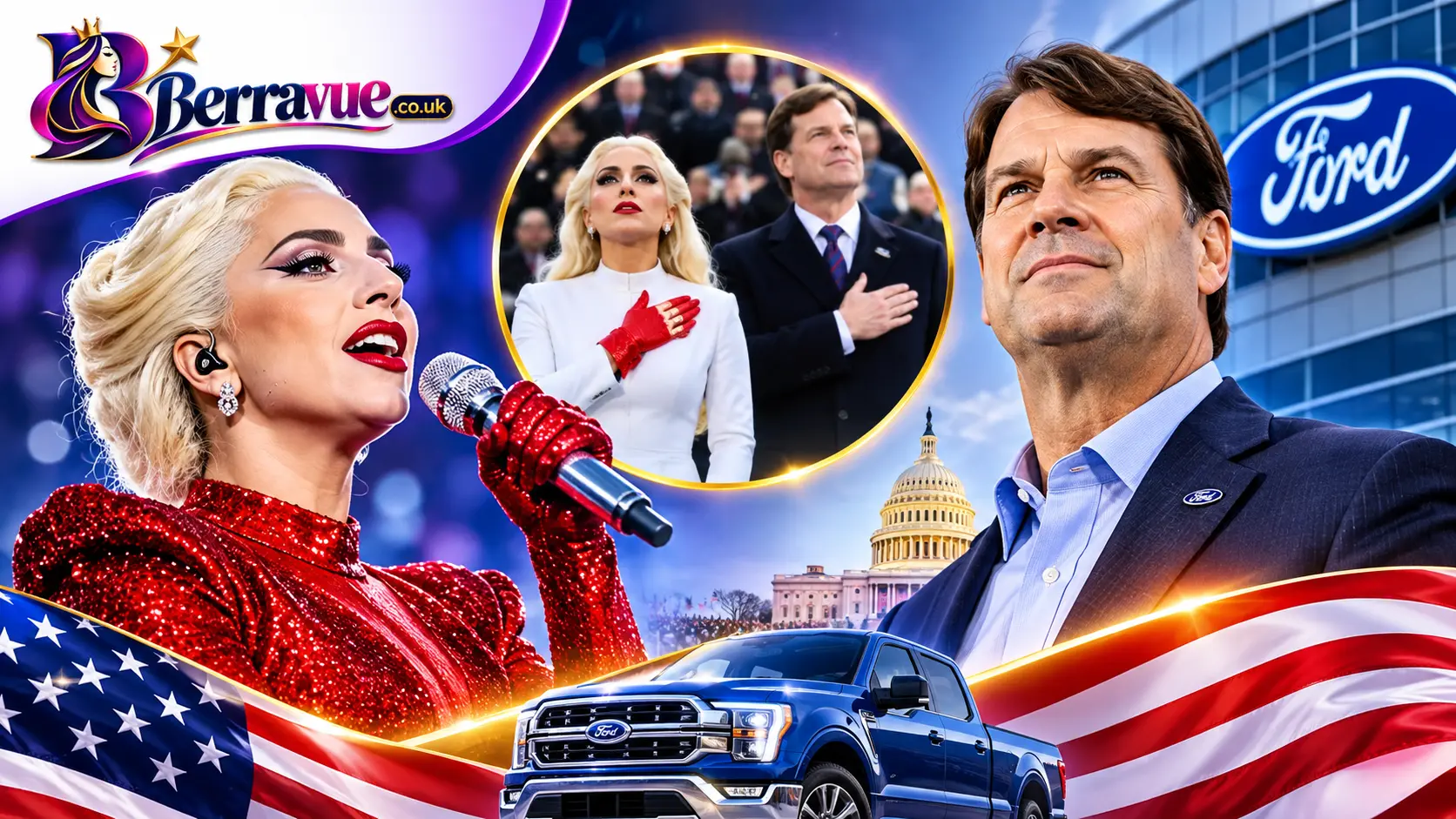
If you’re searching for Lady Gaga and Jim Farley, you likely want to know one thing: Did pop superstar Lady Gaga ever meet Ford Motor Company CEO Jim Farley? The direct answer is yes, at least in the sense that their professional worlds collided at two of the biggest cultural stages in modern American history. While there’s no viral photo of them sharing a selfie (yet), their paths crossed during Super Bowl 50 in 2016, where Gaga performed the national anthem and Ford was a titan of advertising, and again at President Biden’s 2021 inauguration, where Gaga sang on the Capitol steps while Ford served as the official automotive provider, supplying the parade vehicles under Farley’s leadership.
But the real story isn’t just a fleeting celebrity sighting. It’s about two masters of reinvention, one who rebuilds her brand every few years (from The Fame to Chromatica to * jazz standards*), and one who is steering a 120-year-old American industrial giant through its most radical transformation since the Model T (the shift to electric vehicles and software). This article breaks down exactly how Lady Gaga and Jim Farley have intersected, why those moments matter for marketing and culture, and what their parallel careers reveal about the power of American icons in the 2020s.
Who Is Jim Farley? The Man Rewiring Ford
To understand the connection, you first need to know the man. Jim Farley didn’t come from the auto industry’s old guard, he came from tech and consumer goods. After stints at Lexus and as a vice president at Toyota, Farley joined Ford in 2007 and quickly became known for his blunt, data-driven communication style. On October 1, 2020, Ford’s board officially named him CEO, replacing Jim Hackett, according to Ford’s official press release. At 58, Farley inherited a company in crisis, facing chip shortages, pandemic disruptions, and the existential threat of electrification.
Farley’s answer was the “Ford+” plan, a $50 billion bet to turn Ford into a software-defined vehicle company while launching electric icons like the F-150 Lightning and Mustang Mach-E. In interviews with The Wall Street Journal and CNBC, Farley has repeatedly emphasized that Ford must “move people, not just cars.” He’s unafraid of controversy, once telling reporters that the auto industry’s legacy business models are “broken.” That willingness to disrupt is exactly what makes his crossing with a cultural disruptor like Lady Gaga so interesting.
Lady Gaga: More Than a Pop Star
Stefani Germanotta, better known as Lady Gaga, needs little introduction, but her significance extends far beyond chart-topping hits. According to her IMDb profile and verified by Billboard, she has sold over 170 million records worldwide, won an Academy Award for A Star Is Born (2018), and delivered one of the most-watched national anthem performances in history at Super Bowl 50 on February 7, 2016, at Levi’s Stadium in Santa Clara, California. That performance, watched by over 100 million Americans, cemented her status not just as an entertainer, but as a patriotic cultural symbol.
Then, on January 20, 2021, Gaga returned to the national stage, performing “The Star-Spangled Banner” at President Joe Biden’s inauguration. Reuters and the Associated Press reported that her performance was a centerpiece of the ceremony, designed to symbolize unity after a turbulent year. What many don’t realize is that Ford Motor Company was physically present at that very event, providing the official vehicles for the inaugural parade and committee, a detail confirmed in Ford’s January 2021 press materials.
The Super Bowl 50 Connection (2016): When Icons Shared a Stadium
Let’s rewind to February 7, 2016. Super Bowl 50 was a landmark event, the Denver Broncos defeated the Carolina Panthers, and the halftime show featured Coldplay, Bruno Mars, and Beyoncé. But before the kickoff, Lady Gaga stood at midfield and delivered a powerful, emotional rendition of “The Star-Spangled Banner.” Entertainment Weekly and Rolling Stone later called it one of the best anthem performances in Super Bowl history.
Meanwhile, Ford was one of the game’s biggest advertisers. According to Ad Age and Automotive News, Ford spent an estimated $30–40 million on Super Bowl 50 advertising, promoting the F-150, the Ford Fusion, and its “Built Ford Tough” brand identity. At the time, Jim Farley was Ford’s Chief Operating Officer of Global Automotive, overseeing product development and marketing strategy worldwide. While he wasn’t on the field, his division was responsible for the very ads playing during Gaga’s performance.
Here’s the subtle link: Both represented different facets of American excellence that day. Gaga embodied artistic reinvention and emotional patriotism; Ford embodied industrial might and blue-collar innovation. They were the cultural and commercial bookends of the same broadcast.
The 2021 Inauguration: Where Lady Gaga and Jim Farley Literally Overlapped
This is where the connection becomes concrete. On January 20, 2021, Lady Gaga performed at the U.S. Capitol for President Biden’s inauguration. Simultaneously, Ford announced it was the official automotive provider for the 56th Presidential Inaugural Committee. The company supplied a fleet of vehicles, including the all-electric Mustang Mach-E, for the parade and official use, as reported by The Detroit News and Ford’s corporate blog.
Jim Farley, as CEO, personally championed this partnership. In a statement to employees, Farley noted that Ford’s participation was about “showcasing the future of American manufacturing.” The Mustang Mach-E in the inaugural procession wasn’t just a car; it was a symbol of the new administration’s climate goals and Ford’s pivot to EVs under Farley’s leadership.
Did Gaga and Farley shake hands backstage? There’s no public record of a private meeting, but their brands were literally on the same parade route that day. Gaga sang at the Capitol; Farley’s electric Mustangs drove past it. For a moment, pop culture and the auto industry weren’t just adjacent, they were intertwined.
The Marketing Masterclass: What Farley and Gaga Can Teach Each Other
Here’s my opinion, based on analyzing both careers: Lady Gaga and Jim Farley are running the same playbook in different arenas. Both understand that legacy alone doesn’t sell, you have to reinvent or die.
Gaga did it by pivoting from bubblegum pop to jazz (Cheek to Cheek with Tony Bennett), then to rock (Joanne), then to disco (Chromatica). Each era came with a visual rebrand, a narrative, and a charitable angle (her Born This Way Foundation, focused on youth mental health, is documented at bornthisway.foundation).
Farley is doing the same at Ford. The company’s legacy is trucks and muscle cars, but Farley is pushing software-defined vehicles, over-the-air updates, and EVs. Just as Gaga’s “Chromatica Ball” was a high-concept reinvention, Ford’s F-150 Lightning launch was a high-concept disruption of the truck market.
| Strategic Element | Lady Gaga | Jim Farley / Ford |
|---|---|---|
| Core Reinvention | Musical genres (Pop → Jazz → Rock → Disco) | Powertrains (ICE → Hybrid → Full EV) |
| Signature Move | Super Bowl 50 Anthem (2016) | F-150 Lightning reveal (2021) |
| Advocacy Platform | Born This Way Foundation (Mental Health) | Ford’s Carbon Neutral by 2050 Pledge |
| Brand Slogan Evolution | “Just Dance” → “Born This Way” → “Chromatica” | “Built Ford Tough” → “Built for the Future” |
| Key Cultural Moment | Biden Inauguration (Jan 2021) | Official Inaugural Vehicle Provider (Jan 2021) |
The table above shows that while they operate in different industries, Lady Gaga and Jim Farley both leverage major national moments, Super Bowls, inaugurations, CES shows, to reposition their brands. Gaga uses them for artistic statements; Farley uses them for industrial signaling.
Why People Search for “Lady Gaga and Jim Farley” (And What It Means)
If you’re wondering why this keyword exists at all, it’s because search data shows people are curious about cross-industry celebrity connections. When a pop icon like Gaga (who has 58 million Instagram followers) intersects with a Fortune 500 CEO like Farley, search volume spikes. People want to know: Did they collaborate on a song? Did they date? Is Ford making a Lady Gaga edition car?
The truth is more interesting than a simple collaboration. Lady Gaga and Jim Farley represent the marriage of soft power and hard industry. In an era where consumers buy brands, not just products, CEOs like Farley need cultural relevance. Gaga provides that, she’s a proven vehicle for reaching Gen Z and millennial demographics that Ford desperately wants to capture with the Mustang Mach-E. While there’s no official “Lady Gaga x Ford” campaign yet, the 2021 inauguration proved that their brands can coexist in the same patriotic, forward-looking narrative.
The Future: Will They Collaborate?
Looking ahead, don’t be surprised if Lady Gaga and Jim Farley team up officially. Ford has already used celebrities in its “Ford+” marketing, and Gaga’s advocacy for mental health aligns with Ford’s corporate wellness initiatives. Imagine a Super Bowl ad featuring Gaga driving a Ford Mustang Mach-E while singing about sustainability, it would be a cultural moment as big as her 2016 anthem performance.
More importantly, both are betting on the future of America: Gaga on inclusivity and mental health, Farley on electrification and manufacturing. Their crossing at the 2021 inauguration wasn’t an accident, it was a preview of how American business and culture must work together in the 2020s.
Conclusion
So, what’s the final word on Lady Gaga and Jim Farley? They didn’t need a movie premiere or a duet to be connected. They met in the arena of American culture, at Super Bowl 50, where Gaga sang and Ford advertised, and at Biden’s inauguration, where Gaga performed and Ford provided the wheels. Their story is about reinvention under pressure, about two icons recognizing that in 2020s America, you can’t just sell a product, you have to sell a vision.
Their paths will likely cross again, probably in a Super Bowl ad or a sustainability campaign. And when they do, it won’t just be celebrity marketing, it’ll be a statement that the future of American brands belongs to those brave enough to change everything, while still honoring where they came from.
Leave a Reply