

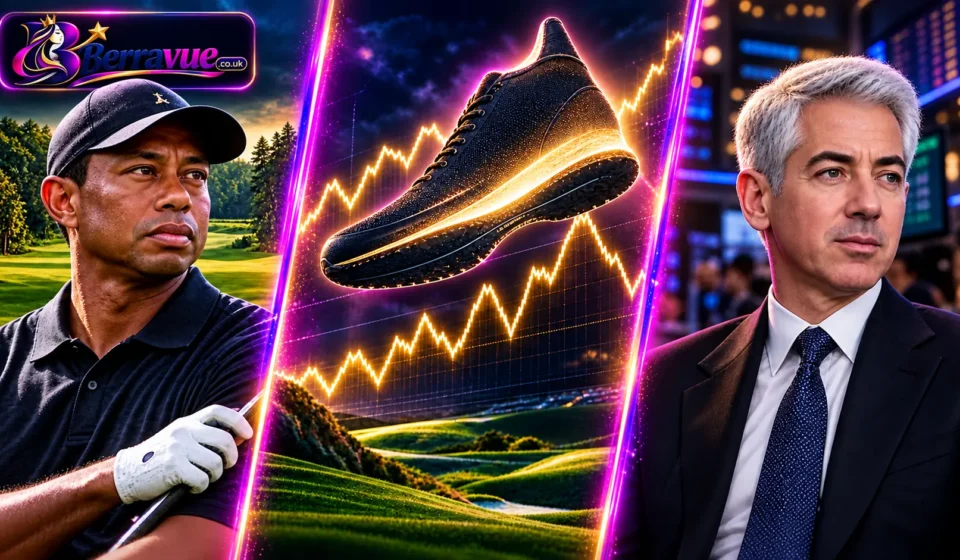

Search “Tiger Woods and Bill Ackman,” and you might expect a golf sponsorship, a charity pro-am, or a business partnership. The real answer is more interesting: there isn’t one. Tiger Woods and Bill Ackman have never worked together, invested together, or even been photographed together at an event. The connection between them is a single sentence in a hedge fund’s investment thesis one that helped move a $30 billion stock and reshaped how Wall Street talks about athlete endorsements.
In 2024, billionaire investor Bill Ackman, founder of Pershing Square Capital Management, built a massive stake in Nike. As part of his public case for why the stock was undervalued, Ackman pointed to a problem hiding in plain sight: Nike’s biggest sports icons, including Tiger Woods and LeBron James, were “aging athletes” who had either left the brand or were unlikely to renew their deals, leaving Nike “with no real superstar from any sport to help engage with younger consumers.”
That one line is the entire “Tiger Woods and Bill Ackman” story. But unpacking it reveals a genuinely useful lesson about how brand power, athlete aging curves, and activist investing collide and why Ackman’s bet on Nike became one of the most closely watched turnaround plays on Wall Street.
Who Is Bill Ackman, and Why Does His Opinion on Nike Matter?
William Albert Ackman, born May 11, 1966, in Chappaqua, New York, is an American billionaire hedge fund manager and Harvard-educated founder of Gotham Partners before launching his current firm, Pershing Square Capital Management. Ackman built his reputation as an activist investor someone who buys large stakes in public companies and then pushes, publicly or privately, for changes in strategy, leadership, or capital allocation. He’s done this at companies ranging from department store chains to consumer goods giants, and his 13F filings (the quarterly disclosures hedge funds must make to the SEC) are watched closely by retail and institutional investors alike because a Pershing Square stake often signals that a beaten-down stock has a turnaround story.
That’s exactly what happened with Nike.
The Nike Bet: A Timeline
By mid-2024, Nike stock had fallen sharply from its highs, weighed down by slowing sales growth, inventory problems, and increased competition from brands like On and Hoka. Ackman saw opportunity where others saw decline.
| Date | Event |
|---|---|
| Q2 2024 | Pershing Square discloses a new position of roughly 3 million Nike shares, at an average cost near $75.37 per share |
| Aug 2024 | Ackman’s investment memo cites weak brand ambassadors specifically naming Tiger Woods and LeBron James as “aging athletes” Nike had lost or was losing |
| Q3–Q4 2024 | Pershing Square increases its Nike stake by roughly 436% between June and September 2024, making it one of the fund’s largest holdings |
| Oct 2024 | Nike brings back company veteran Elliott Hill as CEO out of retirement to lead a turnaround, a move Ackman publicly welcomed |
| Peak 2024 | Pershing Square’s Nike stake reaches roughly $1.4 billion in value |
| Early 2025 | Ackman converts the entire equity stake into deep in-the-money call options with a multi-year expiry, aiming to double his potential return if the turnaround plays out |
| Q1 2025 filings | Nike disappears from Pershing Square’s standard 13F stock listing not because Ackman sold, but because the options structure isn’t reported the same way |
This timeline matters because it shows the Tiger Woods comment wasn’t a throwaway insult it was a specific, load-bearing piece of a much larger, well-documented investment thesis that Ackman backed with real capital and later doubled down on.
What Ackman Actually Said About Tiger Woods
It’s worth being precise here, because headlines have a way of flattening nuance. Ackman didn’t criticize Tiger Woods’s golf game, character, or legacy. His point was about brand marketing economics: Nike’s historic growth engine, the athlete-driven “Jordan Brand” playbook that made stars like Woods, LeBron James, and Michael Jordan into billion-dollar marketing assets, had aged out. Woods and James, in Ackman’s framing, were both nearing or past their competitive peaks and either had already left Nike’s roster or were unlikely to sign new long-term mega-deals.
That’s a fair, if blunt, read of where things stood. Tiger Woods had already ended his 27-year partnership with Nike Golf in early 2024, moving on to a new equipment and apparel arrangement. LeBron James, while still playing, was in the final stretch of a legendary career. Ackman’s argument was that Nike had failed to develop a “next generation” superstar with the same cultural gravity someone who could pull in Gen Z and younger millennial shoppers the way Woods did in golf and James did in basketball during their primes.
In other words, this wasn’t a personal jab at Tiger Woods. It was a warning about Nike’s succession planning.
My Take: Was Ackman Right?
Here’s where I’ll offer a direct opinion, because a good analysis shouldn’t just repeat headlines it should evaluate them.
Ackman’s underlying diagnosis was largely correct, and the market has partly validated it. Nike’s stock had genuinely suffered from a marketing identity crisis: too much reliance on legacy lifestyle sneakers (Air Force 1s, Dunks) and not enough fresh athletic storytelling. Bringing back Elliott Hill, a 32-year company veteran with deep relationships across sport and retail, was widely seen as the right structural fix, and it’s telling that Ackman’s fund grew more confident in the position after Hill’s appointment rather than less.
But I’d push back on one part of the framing: pinning Nike’s ambassador gap specifically on Tiger Woods slightly overstates his marketing centrality at this point in his career. Woods’s商业 impact on Nike had already been in gradual decline for years due to injuries and a reduced tournament schedule his departure was more a symptom of Nike’s broader athlete-pipeline problem than its cause.
LeBron James’s situation was arguably the more urgent gap to fill, given basketball’s outsized role in Nike’s footwear revenue. Naming both athletes together made for a clean soundbite, but the real story is Nike’s failure to sign and build the next Tiger Woods or LeBron James someone in their early-to-mid twenties who could anchor the brand for the next decade. That’s a harder problem than losing an aging star, and it’s the one investors should really be watching.
Why This Story Keeps Resurfacing in Search
Part of why “Tiger Woods and Bill Ackman” is a search query at all is that financial media coverage of 13F filings tends to get recycled, re-quoted, and misattributed over time; some readers land on the phrase secondhand from social media or investing forums without the original context of the Nike thesis. If you’ve searched this exact phrase expecting a scandal, partnership, or feud, the honest answer is that none exists. What does exist is a case study in how a hedge fund manager builds a public investment argument by pointing to concrete, checkable facts athlete contracts, stock filings, and brand strategy rather than vague optimism.
Tiger Woods and Bill Ackman: Quick Facts
| Question | Answer |
|---|---|
| Do Tiger Woods and Bill Ackman know each other personally? | No public evidence of any personal relationship |
| Have they ever done business together? | No |
| What connects them? | Ackman cited Woods as an example of an “aging” Nike ambassador in his 2024 Nike investment thesis |
| Is Nike still a Pershing Square holding? | Yes, via deep in-the-money call options as of 2025, after the fund converted its equity stake |
| Did Tiger Woods respond to Ackman’s comments? | No public response from Woods or his representatives has been reported |
What This Means for Investors and Golf Fans Alike
For investors, the lesson isn’t really about golf it’s about how activist investors read brand risk. Ackman’s willingness to name specific athletes shows that endorsement portfolios are now treated as measurable balance-sheet assets, not just marketing fluff. A company’s roster of spokespeople can factor into a billion-dollar buy decision the same way inventory turnover or gross margin does.
For golf and Tiger Woods fans, the takeaway is a reminder of just how large Woods’s commercial footprint became over nearly three decades large enough that even after his playing days slowed, his name still shows up in hedge fund memos as shorthand for “the last true global sports superstar” a brand could build around. Academic research on celebrity endorsements has specifically studied Woods’s impact on Nike golf ball sales, underscoring how unusually quantifiable his commercial value was compared to most athlete endorsers.
Few athletes in any sport get cited by name in Wall Street investment theses years after their primes — that’s a testament to the endorsement machine Woods and Nike built together in the 2000s, even as it explains why replacing it proved so difficult.
Frequently Asked Questions
Is there a business partnership between Tiger Woods and Bill Ackman?
No. There is no known joint venture, investment, or formal relationship between the two.
Why do people search “Tiger Woods and Bill Ackman” together?
Almost entirely because of Ackman’s 2024 comments about Nike’s aging roster of brand ambassadors, made public through investor letters and interviews covering his firm’s Nike stake.
Did Ackman’s Nike bet pay off?
As of late 2025, Ackman had not exited the position; instead, he converted it into long-dated call options, betting on further upside as Nike’s turnaround under CEO Elliott Hill progresses. Whether the bet ultimately “pays off” depends on Nike’s stock performance over the multi-year window those options cover.
Did Tiger Woods leave Nike because of Bill Ackman’s comments?
No Woods’s departure from Nike Golf was finalized in early 2024, before Ackman’s Nike stake and public commentary became widely reported.